Thursday, 19 June 2014

Catching up on Waxen City Part II

 June 1 - June 15--Queen Olivia is getting frisky!

I decided to go through Olivia from top to bottom to see how she was doing.  She is a booming hive and that makes me nervous.  You all know by now that a healthy hive wants to split (swarm) to reproduce and she is soooo healthy.  My goal this season is to learn how to keep the hives from swarming.  It's my responsibility as an urban beekeeper to avoid swarms since it is so epic when they swarm. I also want to learn to avoid them since a pile of honey and 1/2 the bees go with the swarm and that is a great loss.  Also, the hive has to make a new queen which takes time and sets the colony back.

Olivia has tons of capped brood and tons of open brood.  I added open frames between all the frames of brood again.  I added a box of empty frames for honey storage.  I didn't find the queen but all seemed well until I spotted one queen cell with a larva in it.  There were nurse bees feeding it!  Yikes!    The cell is in the centre of the frame which usually means supersedure (something wrong with the queen so the bees have to make a new queen) so now it is even more important to find the queen.  I will have to go in again as soon as possible to see what is up. I'm nervous!

Queen cell with larva being fed
I then went into Mab who is looking really good.  I am continuing to add frames to keep the brood open and hope that this will do the trick.  I found her majesty...though she seems slow, she is a great layer and I think that I have underestimated her.

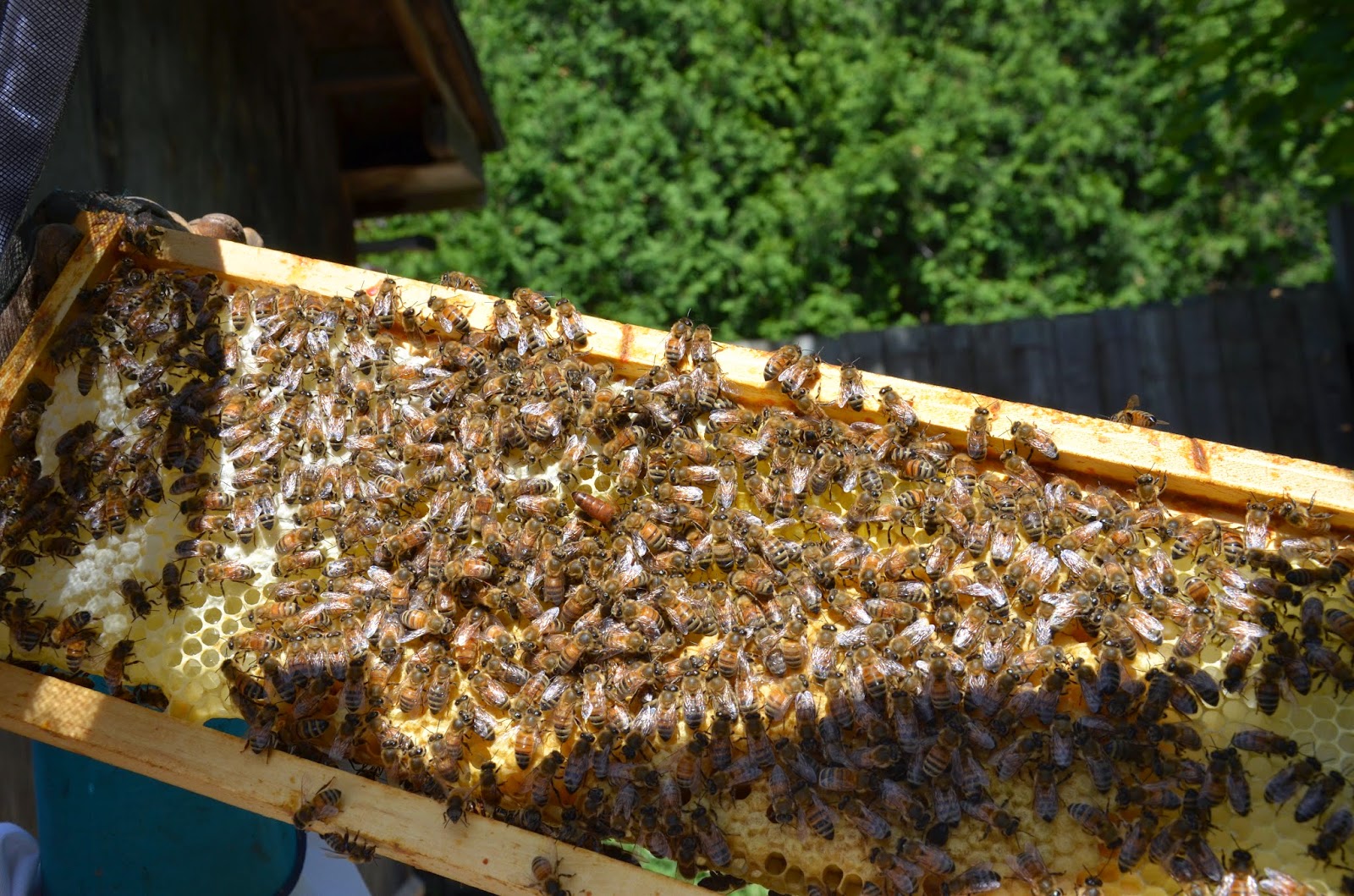
Her Majesty Queen Mab and her retinue
She is a gorgeous fat queen with lovely stripes...a combination of Ontario genes mixed with Buckfast.  I have been worried about her since she comes from a queen who swarmed very early in the season last year.

June 15  Fathers Day            

Queen Olivia sets her sights on the horizon!  With trepidation I went into Olivia to see why I had found a queen cup with larva.  Worse and worse, I found about 8 capped queen cups throughout the hive!  Some of the capped queen cells were on the bottom and some in the centre of the frames.  The hive was very agitated.  I had Kelly visiting today and found that I had difficulty making a decision about what to do.  Was Olivia planning to swarm or had something bad happened to the queen and was the hive  trying to replace her?  As we went through the hive we finally found Queen Olivia in the last box we checked.  She was a lot skinnier than the last time we saw her which should have told me what was up immediately.  When a queen decides that it is time to swarm she will lay eggs in queen cups for the workers to take care of.  She will also start losing weight to get ready to fly again.  Remember that she has not flown since she was fertilized so she needs to do some yoga and exercise to get fit.


Capped queen cell

Queen Olivia...see if you can find her

Queen Olivia laying eggs...her butt is in a cell
I took off my gear and sat with a glass of ice water to think about my next steps.  I decided that the only thing I could do would be to build a whole new hive with all the queen cells.  I waited an hour to let Olivia stop being so angry about being taken apart since I knew I would be doing exactly the same thing again.

I found every single frame with queen cells and put them into a new box.  I added honey frames and a lot of frames with capped and open brood so there would be lots of workers in the hive.  I made sure to find the queen again so that I didn't accidentally put her in the new hive.  This new hive ended up being three boxes high with the top box being full of nectar frames.  I also added empty frames to give them work.  Here is the math of what happened in Olivia and what should happen in this hive:

June 4    Olivia laid the eggs in the queen cups.
June 7    The eggs hatch into larva which I spotted on June 9
June 12   The queen cups get capped and the larva goes through changes
June 15    I moved the queen cups into the new hive.               
June 20   The queen emerges and if she is first she kills all other queens in their cells
June 24   The queen has oriented herself and is ready to fly out to be fertilized by drones
July 3      The queen starts to lay 2000 eggs per day and never leaves the hive again...unless...sigh...

Building the new hive
So now I am the proud owner of three hives!  

Three hive bee yard!
I put a branch in front of the new hives opening so that the bees become aware of the change.  Most of the foragers were out so they will go back to their original hive.  As the brood emerges the new hive will build its own foragers.  The queen won't be laying until the beginning of July so this hive will have a gap in its timing and hopefully I have given it enough bees and honey to keep it going.

New hive with branch crossing opening
Olivia is already more relaxed and is buzzing away like nothing happened.    This is all very exciting and if it works I will still have succeeded in avoiding a swarm...the split that I just did is also known as an artificial swarm since Olivia will think that she has in fact swarmed (kind of).  Mab didn't even notice all the commotion next door.

My next job will be to check Mab to make sure she isn't having similar urges.  I will also check the new hive to see if a queen has emerged.  Next post!


Catching up with Waxen City news Part I

Diary of events from May 11 - May 25 2014

Sorry to have been silent for so long!  No excuses...just apologies!

May 11
Spring!!!  Finally got to go into the bees as the weather was showing signs of warming up.  Blooming plants all around.


Spring!  Trillium in bloom

Redbud

Pear blossoms

Queen Olivia is booming.  I added empty frames between her brood to keep her working instead of thinking of swarming.  I also added two boxes on top to keep her busy.  Found her Majesty laying and ignoring me entirely.  I also gave her a screened bottom for ventilation.


Queen Olivia


Queen Mab looked like she was struggling so I went through all of her boxes.  I found that her bottom board was a sodden mess as the plywood had soaked up all moisture.  There was mold and a pile of dead bees in the bottom.  I cleaned it all up and gave her a screened bottom for ventilation.  Right away the hive seemed happier.

Victoria Day  May 19
Gorgeous day!  Had a bee lover join me for my bee check.  Went into Olivia just to give her a look at a very healthy hive.  We found Queen Olivia easily...she was hard at work with no interest in us.

Apprentice Kelly
We then went into Mab and found her majesty!  She looked very slow and sluggish so we thought we should give her some honey from Olivia to make sure the hive kept going. Very exciting for Kelly to see both queens on her first visit...also exciting for me.  We also found an empty queen cup...nothing to worry about as there was no egg or larva in it.

Empty queen cup

Beautiful lady slipper

Honey bee on dandelion...first source of pollen
May 25
Kelly joined me again and we added empty frames into Olivia and gave a quick check in Mab.   She was starting to strengthen and the hive was busier.  The weather is starting to be lovely and people are much friendlier.  I am starting to dream of gardening.

End of Part I

Sunday, 1 June 2014

Politics, pesticides and bees...oh my!

June 1, 2014

Ontario is in election mode...voting day is June 12.  If you are wondering how to choose one party over another, how about thinking about the bees and checking out their platforms on the environment.

The Ontario Beekeepers Association is a very quiet organization but they have become vocal as it becomes increasingly obvious that neonicotinoids, pesticides made by Bayer and Syngenta are causing havoc with bee health as well as native pollinators.  It is also very obvious that our politicians are unwilling to go up against these corporate giants and keep handing the decision making to other levels of government.

Here is the OBA's press release for you to look at.  Ask all your candidates these questions and see if they have an answer...if they have even thought about it.

I cannot think of any issue as pressing as this one not because I am a beekeeper but because the health of the bees is an indicator of the health of the world.

Check out your candidate and their stance.  Whatever party you vote for...make sure you vote!

PRESS RELEASE

Ontario’s political parties express positions on bee health

 Milton, ON, May 28, 2014. The Ontario Beekeepers’ Association has surveyed each of the four major parties running in this year’s provincial election for their plan to solve Ontario’s current bee health crisis.
 In 2012 and 2013, over 14,000 hives were lost to bee kills linked to the indiscriminate use of neonicotinoid pesticides by Health Canada. Last year, nearly 99% of the 2.2 million acres of corn in Ontario were treated with neonicotinoids, even though the Ontario Ministry of Food and Agriculture crop specialists indicate that only 10% to 20% of acreage needs pest protection.
 The OBA has released a revised position on neonicotinoids and bee health. The new position calls for a moratorium on the sale of neonicotinoid treated seeds but offers the option for farmers to apply for one-time use if they can a demonstrate, through an approved soil test or monitoring program, a problem that requires neonicotinoid-treated seeds.  This position is consistent with that adopted by the National Farmers Union.
 Two questions were asked via email to the leaders of the Ontario PC, Ontario Liberal, Ontario NDP and Green Party of Ontario:
1)     Ontario's beekeeping industry has suffered through the loss of thousands of hives in both 2012 and 2013 that Health Canada has confirmed were the result of exposure to neonicotinoid pesticides in soy and corn planting. Should you be elected to lead the Government of Ontario, would you support the Ontario Beekeepers' Association's call for an immediate moratorium on the sale of the neonicotinoid treated seeds that are killing our bees?
2)     Ontario is suffering a serious decline in the population of the insect pollinators we rely on for our locally grown foods as the result of the indiscriminate use of neonicotinoid pesticides. Health Canada and other studies have shown significant amounts of persistent neonicotinoid pesticides in water and soil samples across Ontario. If elected, will your party declare this an urgent environmental problem?

Tuesday, 1 April 2014

Is Spring Really Coming?

April 1, 2014

The bee yard one month ago in the "thaw"

Wow!  It's 14 degrees C today though it feels like 8 degrees C.  I can see everyone's shoulders starting to relax as they cautiously dream of warm weather.  Our property still has many snow patches around but they are retreating and exposing bits of brown and green...at long last.

The bees are starting to feel it too.  Two days ago it was 4 degrees C and sunny and I was home.  At noon I took the chance to take a look in the hives.  I wanted to give them some sugar to help them get through the next few weeks since there is absolutely nothing out there for them to eat...and I was very curious.  It has been such a long and brutally cold winter I wasn't sure what I would find.

I opened Queen Mab II first and was very surprised and pleased to find the cluster in the top box as if they were waiting for me.  She has 6 full frames of bees and looks very active.

Queen Mab with a 6 frame sized cluster

I added an empty box on top so I could give her some granulated sugar to keep her going.  The first source of food will be the silver maple when it blooms and though I see a bit of fuzziness on the tree on our property, I think it will be at least two weeks before there is forage for the bees.  It will be a tricky balance for the next while since the sugar will stimulate the queen to lay but there won't be enough food to keep a whole lot of brood alive.  I will try not to overfeed and the minute the trees bloom I will stop.

Next I opened Queen Olivia, my awesome Australian hive.  She had 8 full frames and looks amazing!  


Healthy Queen Olivia with an 8 frame cluster

I added the empty box and gave her sugar as well.

Adding sugar onto newspaper in Queen Olivia

I then went into Queen Sangria.  She was very small going into the winter and I knew that she might not make it.  Sadly, I found what I expected...a small, dead cluster of bees.  She just couldn't keep warm enough with so few bees.  

Dead cluster of bees in Queen Sangria

Later that afternoon both Queen Mab and Queen Olivia were really busy enjoying the sunshine.  I will check on their sugar stores in a few days and hope for budding maples.

Lively Queen Olivia in the sun

So the bee season is off and we will see what the future brings.  A loss of 33% or a success rate of 66%...it all depends on your perspective!


Sunday, 5 January 2014

Happy New Year 2014

Jan 5, 2014

Happy New Year to all of you!  I haven't written since August.  Apologies!  I am looking out the window at a grey day with falling snow that threatens to continue all day long.  We have just gone through a cold snap that saw the temperatures during the day go as low as minus 26  (centigrade) with the wind chill.  Brrr.  No bees to be seen during that time but as soon as it warmed up to minus 2, the bees came out for cleansing flights and clearing out their dead.  There were about 10 bees dead in the snow outside of the hives after this.

These are the little signs that let me know that there is still life in the hives.  Another sign that gives me hope is the melting of the snow around the opening that shows that the bees are heating the cluster.

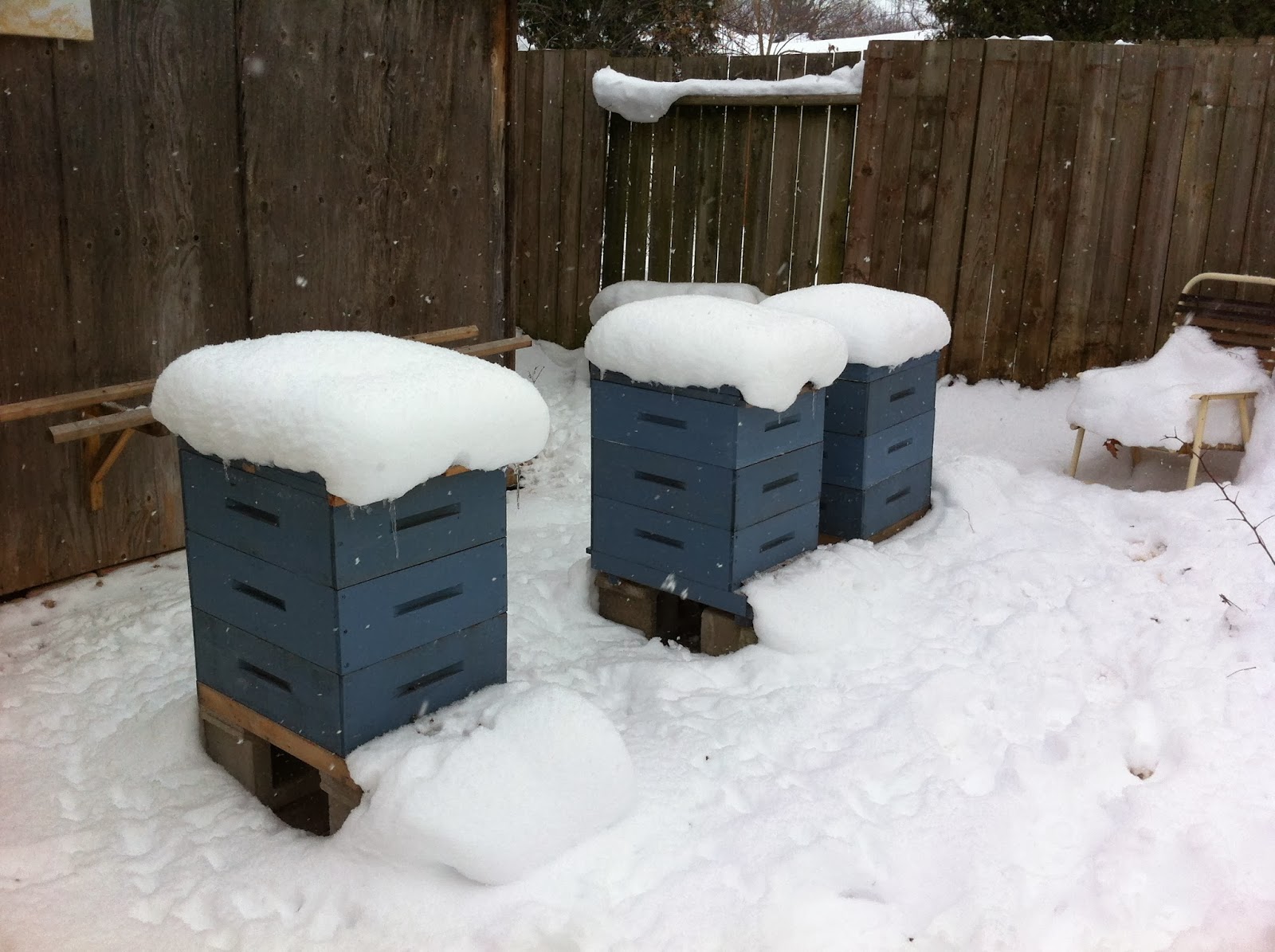
Heavy snowfall on the hives in November 2013.  Melted snow around openings.

Here's a little update on the state of each hive and what we can expect from them in the spring.

Queen Mab II:  This hive started with an Ontario queen, was doing very well and decided to swarm in June last summer.  I let her build her own queen and rebuild the hive on her own since there were no queens to be had and it was still early enough in the season.  I did not take any honey from her last summer.  So Queen Mab II is a new  Ontario queen and will be about 3/4 year old in the spring.  She should be fairly robust in numbers.

Queen Olivia:  This hive started with an Australian queen and was the star hive last summer.  She never showed any interest in swarming and built up very quickly.  I took about 3 frames of honey to harvest from her.  She is going into the new season with a mature queen so I will have to watch her carefully to make sure she doesn't swarm.  I will probably have to do a split very early in the spring.

Queen Sangria:  This is my experimental hive.  She is made up of a queen from one of the swarm cells from Queen Mab that I took when she was making queens  I added bees and brood from Queen Olivia.  To keep her fed through the winter I gave her a full box of capped honey from Queen Olivia.  I could have harvested all of that for us but instead I am buying honey from the market!  Queen Sangria is a new Ontario queen and will be the same age as Queen Mab II but will not be near as robust.  It will be amazing if she makes it through this long, cold winter but it will be a good experiment regardless of the outcome.

I will be spending the next three months preparing boxes for the splitting of the hives, with the help of my handy husband, Bill.  My challenge is to avoid any swarming this coming spring...at least of my own bees!  

So  now we  wait for spring.  I keep the bird feeders full of seed for the juncos, woodpeckers, cardinals, chickadees, sparrows, nut hatches and mourning doves that visit the back yard every day.  Sometimes we see a skunk or opossum slide through the snow drifts and of course, dozens of grey and black squirrels.  Recently, it was so cold, I couldn't see through the frost on the window of the back door so I took a picture with my very cool new macro lens on my I-phone.

Macro picture of fern-like frost on the back window.
This is what I see when the window is not covered with frost, taken with the very cool fish-eye lens on my I-phone.

Snow bound Ontario

I wish you all the best in this brand new 2014!


Sunday, 18 August 2013

July to August Bee Diary

Aug 18, 2013
 It's been a month since I have written. I have been into the bees many times since that last post so I thought I'd better catch you up with a few notes and some visuals.

July 7 Looking for the New Queens

I knew it was a little early to be looking for hatched and/or fertilized queens but since I was heading out of town for a while, I thought I would check. I had a couple of hope-to-be beekeepers coming to visit so I knew it would be interesting for them as well. I opened the experimental hive first. The queens had not hatched yet but the worker bees that I had grabbed from Queen Olivia to populate the hive had decided to build another queen in response to this queenless hive. I removed this queen cell fdue to my human need to meddle! Here is the frame with the queen cells still capped and my visitors looking at a frame.

Capped Queen cells on bottom of frame


Melodie and Gerhard

July 11  First Honey Harvest of Summer 2013

I took 3 frames of capped honey from Queen Olivia and Queen Mab II to harvest since they had a bit of surplus.  I am using the crush and strain method now instead of using my beautiful extractor.  I cut the whole comb out of the frame and let the honey drip through a nylon cloth.  In some ways it is faster as I only do a few frames at a time and I don't have to clean out the extractor every time.


Cutting the honey comb out of the frame.

Bill made me a beautiful shelf for the beeyard for setting the boxes on.  Its cross pieces have a point cut into them so there is as little contact as possible with the boxes.  This way the squishing of bees is minimized.  An awesome addition to the beeyard--good for the bees and my back!

Perfect shelf to hold the boxes

July 17  Hot Bees

It may be hard to believe that we went through a heat wave that had everyone and everything drooping.  It went as high as 35 degrees but was feeling like 42 degrees with the humidity.  It felt like it lasted forever though it was in reality only about a week and half. We had all our fans going non-stop to deal with it.  The bees were madly fanning as well and hanging on their front porches day and night.

Queen Mab II and Queen Olivia cooling off

July 23  Introducing Queen Sangria

I finally got a chance to go into the hives to see if the queens had hatched and been fertilized.  It was a cool and sunny day.  I went into my experimental hive first and there she was!  A big, striped queen laying eggs.  There was new brood and new wax being drawn.  (My great nieces Madison and Megan named her Queen Sangria as that is the drink of choice this summer.)  I gave this hive a box of frames on top to give them some room.  I then went to Queen Mab II.  Though I did not find her Majesty, it was very clear that she was doing great since there was evidence of laying.

Queen Sangria--you can find her!

August 4  Fixing "wonky honey comb"

I figured I'd better look into Queen Olivia, my star hive to see if there was any surplus honey to be harvested.  What I found was "wonky honey comb".  Since I don't use plastic foundation, the bees are left to their own devices to build straight combs.  Mostly they do, but in this hive they had built on angle so each comb started in one frame and then half way through continued to the next frame.  This makes taking the frames out singly impossible without making a very sticky mess.  I took out 5 capped frames to harvest and then tried to fix the rest with wire.  Honey was dripping everywhere and the bees were in a frenzy trying to clean it up before strange bees or wasps happened upon the mess.  Once I had the broken comb fixed I gave it to Queen Sangria to eat/clean up.

Wiring the combs back into the frames

August 17  Bee Check

It has been unseasonably cool these last two weeks with temperatures going as low as 12 degrees some nights.  I imagine the nectar production is limited though I have seen a lot of pollen going into the hives.

It was time to see if the hives needed more room and if all was well.  I checked Queen Sangria and found her Majesty happily laying.  They still hadn't done much work in their extra box but I saw that they had cleaned out the two fixed frames completely which supports the theory that there hasn't been much nectar.  I hope that she can build up the population to a large enough cluster to make it through the winter.  If she doesn't I will have to amalgamate her with another hive.

I opened up Queen Olivia and also found her Majesty working in the bottom box.  There hasn't been a lot of honey production in her either so I left all frames in.  To tell the truth, I wasn't that interested in harvesting honey this weekend anyway.  

Busy doorway at Queen Olivia

I then went into Queen Mab II.  For the first time ever, I found her Majesty!  She was working in the second box from the bottom  She is striped just like Queen Sangria, as they are related, if not full sisters.  The hive looks busy and healthy but I did spot a varroa mite on one of the workers.  Of course, I knew that all the hives must have mites but it is still disappointing to see one.  We will see how the hives do.

Queen Mab II--right in the middle of her retinue

So there's your little update on the bees of Waxen City.  I have harvested about 23 lbs of honey.  The first harvest has an extremely floral taste...perhaps linden tree?  The second harvest is just plain sweet!  It is still a wonderful hobby.  I feel that I learn something new each time I go into the hives and I have become more calm and relaxed as I work with them.  

I know that there has been a lot of media around honey bees and other pollinators and their precarious position in our world.  I will write again about that and the ominous possibility of a world without bees but for now, enjoy the sunshine and the incredible Ontario harvest of fruits and vegetables available at our markets.   I leave you with an image of a Red Admiral butterfly on an echinacea blossom.

Red Admiral butterfly on echinacea


Thursday, 4 July 2013

Queen Rearing Workshop in Burgessville Part 2

The beautiful view at John's bee yard

June 19, 2013

And the story of queen rearing continues.

Day 21 - 26:  The fertilized queen has returned from her fertilizing flights to mating hive and is laying eggs.  The hive should be checked at this point to make sure that she has come back safely and is indeed laying.  She can then be caught, marked and caged to be added to a hive that needs a queen.  Marking the queen tells you what year she was born.  There is an international code for marking queens:

Colour          Year ending in

White            1 or 6
Yellow          2 or 7
Red               3 or 8
Green            4 or 9
Blue              5 or 0

Take the first letter of each colour and say "Will You Raise Good Bees?" to remember the colour chart.

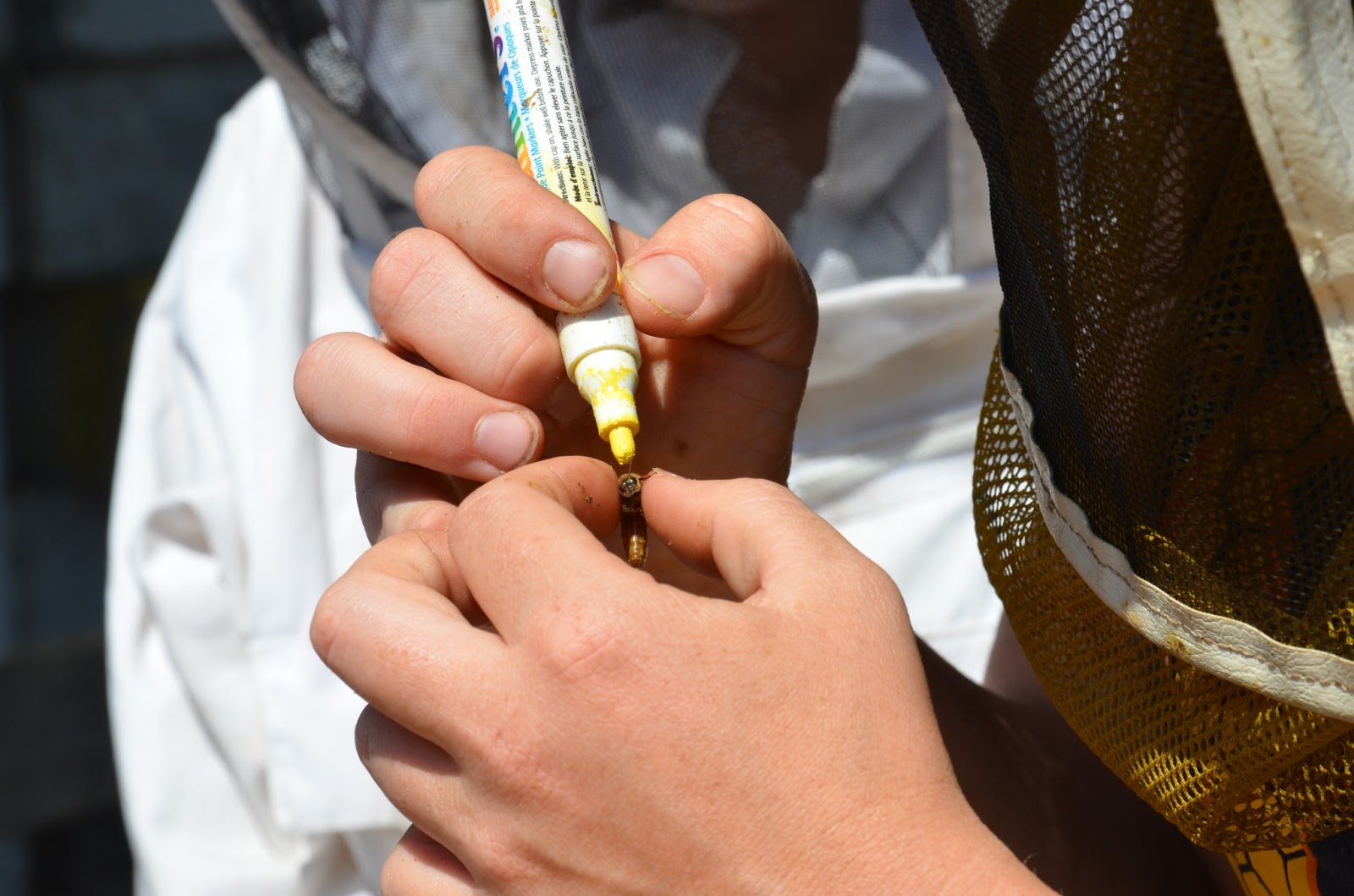
We practised picking up drones by the wings and then marking them.  Drones can't sting and are not as "valuable" as queens.
Marking a drone with a paint marker
The queen can then be caged with 5-8 attendant bees (young bees that care for the queen) and some queen candy (fondant).  The candy acts as a slow-release plug.  The cage is added to an existing queenless hive and the workers in the hive eat away the candy.  As they work they slowly become accustomed to the pheremone of the queen and learn to accept her.  When the candy is all eaten the queen can come out, be accepted by the population and start laying.

Queen Cage installed on frame

Plastic and wooden queen cages


It was so cool to be hanging out with a bunch of fellow bee keepers in the beautiful Ontario countryside.  Some of us were new bee keepers and some with many years of experience and we all had different reasons for wanting to learn about queen rearing.  I was there purely to satisfy my curiosity and others wanted to be able to raise their own queens to make sure that they would have a supply when queens were needed or to save money on re-queening.

Beekeepers with trainer (the one in bare arms!)

I will probably never raise queens since I only have two hives but I learned so much about the biology of bees.  I also learned to be more comfortable around the bees...John's bees are very gentle and I was working barehanded the entire day.  The most exciting thing for me was picking up a drone to mark it.  Bare hands are necessary for this fine work.  That is not to say that I will be that cocky always...I do not enjoy being stung!

Proud graduates!

We drove home after the workshop tired and fulfilled.  A great day for all of us!